INTERNATIONAL EXTRADITION · AFRICA
Extradition from Nigeria to the United States.
1931 U.S.-United Kingdom Extradition Treaty, extended to the Nigeria Protectorate and continued after independence controls the request. The treaty itself does not impose a blanket nationality prohibition. The arrest clock and local review path decide what happens next.

THE SHORT ANSWER
In force according to U.S. Code and current bilateral practice No reliable official general duration. The 2012 Mustapha case involved arrest in March 2011 and extradition in February 2012, but one example is not a standard.
1931 U.S.-United Kingdom Extradition Treaty, extended to the Nigeria Protectorate and continued after independence
Effective: 1935-06-24
WHAT COUNSEL CHECKS FIRST
The active paper. The country. The clock.
THE RESPONSE ROOM
What has to be established first.
FIRST HOURS
Identify the legal basis for custody
Record the arresting authority, court, case number, custody location, interpreter need, and any hearing date. Ask for counsel before discussing the foreign accusation.
WHO DECIDES
The local record controls
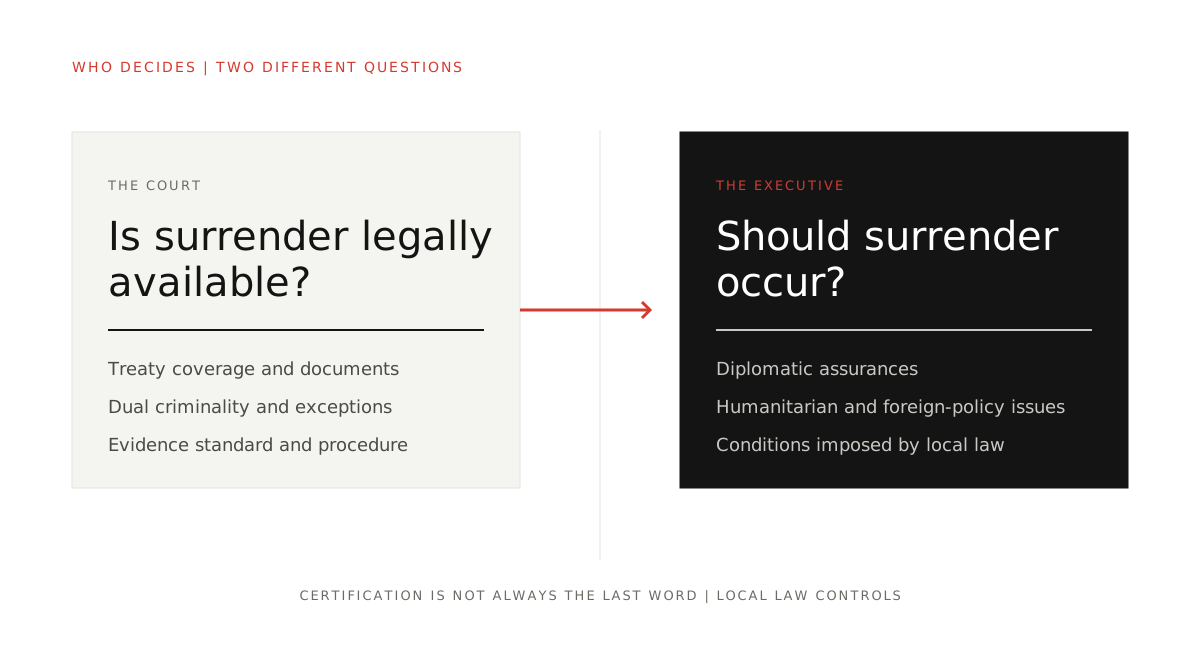
A request goes through diplomatic channels to Nigeria's Attorney General of the Federation. The Attorney General may issue an authority to proceed; a Federal High Court magistrate/judge conducts the judicial inquiry, and surrender follows only after statutory certification and executive action.
THE CLOCK
Deadlines are event-specific
Article 9 permits urgent provisional arrest on a warrant/complaint or authenticated notice. Release follows if the requisition is not made within two months, subject to the treaty and Nigerian implementing procedure. No reliable official general duration. The 2012 Mustapha case involved arrest in March 2011 and extradition in February 2012, but one example is not a standard.
DOCUMENT AUDIT
Build the file before the argument
Preserve the notice or warrant, charging papers, identity records, release terms, travel documents, medical records, and every dated communication. Do not alter or delete evidence.
FOR FAMILIES COORDINATING ACROSS BORDERS
Confirm the exact legal name, detention location, medication needs, next hearing, local lawyer, and one reliable contact channel. A consulate may assist with welfare and contact; it cannot cancel the local case.
02 · THE PROCESS
How the Nigeria process moves.
Judicial and executive stages
A request goes through diplomatic channels to Nigeria's Attorney General of the Federation. The Attorney General may issue an authority to proceed; a Federal High Court magistrate/judge conducts the judicial inquiry, and surrender follows only after statutory certification and executive action.
Appeal and review
Federal High Court decisions and detention issues may be challenged through Nigeria's appellate courts; constitutional fundamental-rights proceedings may also arise.
03 · DEFENSES
The request still has to survive the record.
ISSUE
Treaty coverage
The charged conduct, punishment threshold, documents, and identity must fit the controlling treaty and local implementing law.
ISSUE
Dual criminality
The 1931 treaty is list-based, although listed categories are interpreted with domestic law and some multilateral conventions can provide additional authority. Modern dual-criminality similarity alone may not cure an unlisted offense.
ISSUE
Political and protected offenses
Political offenses are excluded. The treaty lists offenses and contains lapse-of-time rules; military and revenue conduct require list/statutory analysis. Nigeria's Extradition Act adds mandatory and discretionary restrictions.
ISSUE
Evidence and process
The request can be tested against the treaty standard, authentication requirements, limitation rules, and procedural guarantees that apply locally.
ISSUE
Human rights and punishment
Nigeria retains the death penalty for some offenses. When Nigeria requests surrender from an abolitionist jurisdiction, assurances may be required; when the United States requests surrender, Nigerian constitutional fair-hearing, prison, health and abuse-of-process claims may be litigated.
ISSUE
Specialty and assurances
Yes; the treaty limits prosecution after surrender to the extradition offense(s) subject to its terms.
04 · PUBLIC EXAMPLES
Recent public extradition records.
These examples come from public government records and are not presented as Spodek Law Group matters or results.
Rasheed Mustapha
mail-fraud and money-laundering conspiracies, 401(k) theft and aggravated identity theft
05 · THE CHARGES
What appears in the requests.
A Red Notice is not the extradition order.
A Red Notice asks police worldwide to locate and provisionally arrest a person, subject to each country's law. It is not an international arrest warrant, and it does not replace the treaty papers or the local extradition case.
The notice, the provisional-arrest request, and the surrender proceeding are separate records. Each can carry different defects, deadlines, and remedies.
07 · THIRD-COUNTRY RISK
Transit can expose a person to another country's arrest rules, immigration powers, or provisional request. This page gives no route or evasion advice. Review the actual warrant, notice, release conditions, and jurisdictions with counsel before travel.
08 · QUESTIONS
What families and targets ask first.
IMMEDIATE EXTRADITION QUESTIONS
It can. Border screening may expose a national warrant, INTERPOL data, immigration authority, or a provisional request under another country's law. This is not travel or evasion advice; the actual records and jurisdictions require review before travel.
AUTHORITIESwww.interpol.int
Release depends on Nigeria's current law, the arrest authority, flight-risk findings, and the stage of the request. No general website answer can predict it. Local counsel should address custody while U.S. counsel verifies the federal matter and request.
AUTHORITIESwww.justice.gov
Not automatically. Extradition, asylum, immigration removal, and non-refoulement are separate legal systems that may interact. The forum, protected status, alleged conduct, treaty, and current human-rights evidence determine which arguments are available.
AUTHORITIESwww.justice.gov
COUNTRY PROCEDURE
Yes. 1931 U.S.-United Kingdom Extradition Treaty, extended to the Nigeria Protectorate and continued after independence is in force according to u.s. code and current bilateral practice; the stated effective date is 1935-06-24. Always verify treaty status with the U.S. State Department/Office of International Affairs for a live case.
AUTHORITIESwww.govinfo.govwww.govinfo.gov
The treaty itself does not impose a blanket nationality prohibition. Nigeria's Extradition Act gives the Attorney General a central role and allows statutory refusal/discretion questions, including nationality-related considerations, to be addressed under Nigerian law; citizenship is not safely described as an automatic bar.
AUTHORITIESwww.govinfo.govwww.vertic.org
The 1931 treaty is list-based, although listed categories are interpreted with domestic law and some multilateral conventions can provide additional authority. Modern dual-criminality similarity alone may not cure an unlisted offense.
AUTHORITIESwww.govinfo.govwww.congress.gov
Article 9 permits urgent provisional arrest on a warrant/complaint or authenticated notice. Release follows if the requisition is not made within two months, subject to the treaty and Nigerian implementing procedure.
AUTHORITIESwww.govinfo.govwww.justice.gov
A request goes through diplomatic channels to Nigeria's Attorney General of the Federation. The Attorney General may issue an authority to proceed; a Federal High Court magistrate/judge conducts the judicial inquiry, and surrender follows only after statutory certification and executive action.
AUTHORITIESwww.vertic.orgwww.justice.gov
Federal High Court decisions and detention issues may be challenged through Nigeria's appellate courts; constitutional fundamental-rights proceedings may also arise.
AUTHORITIESwww.vertic.org
Nigeria retains the death penalty for some offenses. When Nigeria requests surrender from an abolitionist jurisdiction, assurances may be required; when the United States requests surrender, Nigerian constitutional fair-hearing, prison, health and abuse-of-process claims may be litigated.
AUTHORITIESwww.govinfo.govwww.congress.gov
No. A Red Notice is a request to locate and provisionally arrest, not an international arrest warrant or a judicial finding of extraditability. Domestic law and the treaty still control arrest and surrender.
AUTHORITIESwww.interpol.int
Yes; the treaty limits prosecution after surrender to the extradition offense(s) subject to its terms.
AUTHORITIESwww.govinfo.govwww.congress.gov
No reliable official general duration. The 2012 Mustapha case involved arrest in March 2011 and extradition in February 2012, but one example is not a standard.
AUTHORITIESwww.justice.govwww.justice.gov
10 · SOURCES
Every material claim should have a file behind it.
11 · REGIONAL INDEX
Related country files.

WHO REVIEWS THE FIRST CALL
Start with the paper, the posture, and the first deadline.
Todd A. Spodek leads the firm's federal defense work. The team identifies the active U.S. matter, the country and custody posture, and where appropriately licensed local counsel is required. No webpage can replace review of the actual request.
Todd Spodek - biography and record →SECURE CONSULTATION REQUEST
Put the actual extradition record in front of counsel.
Tell us whether this is an inquiry, Red Notice, detention, hearing, or appeal. The intake team will identify conflicts and the right next step. Urgent custody and hearing matters should call.
212 300 5196 - urgent matters →