INTERNATIONAL EXTRADITION · NORTH AMERICA
Extradition from Canada to the United States.
Treaty on Extradition (1971), as amended by the 1988 and 2001 protocols controls the request. Nationality is not a bar. The arrest clock and local review path decide what happens next.

THE SHORT ANSWER
In force There is no reliable official average. The statutory 90-day ministerial decision period is not a total-case deadline. Record preparation, committal proceedings, appeal, judicial review, Supreme Court leave, assurances and concurrent Canadian charges can extend the matter for years.
Treaty on Extradition (1971), as amended by the 1988 and 2001 protocols
Effective: 1976-03-22; first protocol effective 1991-11-26; second protocol effective 2003-04-30
WHAT COUNSEL CHECKS FIRST
The active paper. The country. The clock.
THE RESPONSE ROOM
What has to be established first.
FIRST HOURS
Identify the legal basis for custody
Record the arresting authority, court, case number, custody location, interpreter need, and any hearing date. Ask for counsel before discussing the foreign accusation.
WHO DECIDES
The local record controls
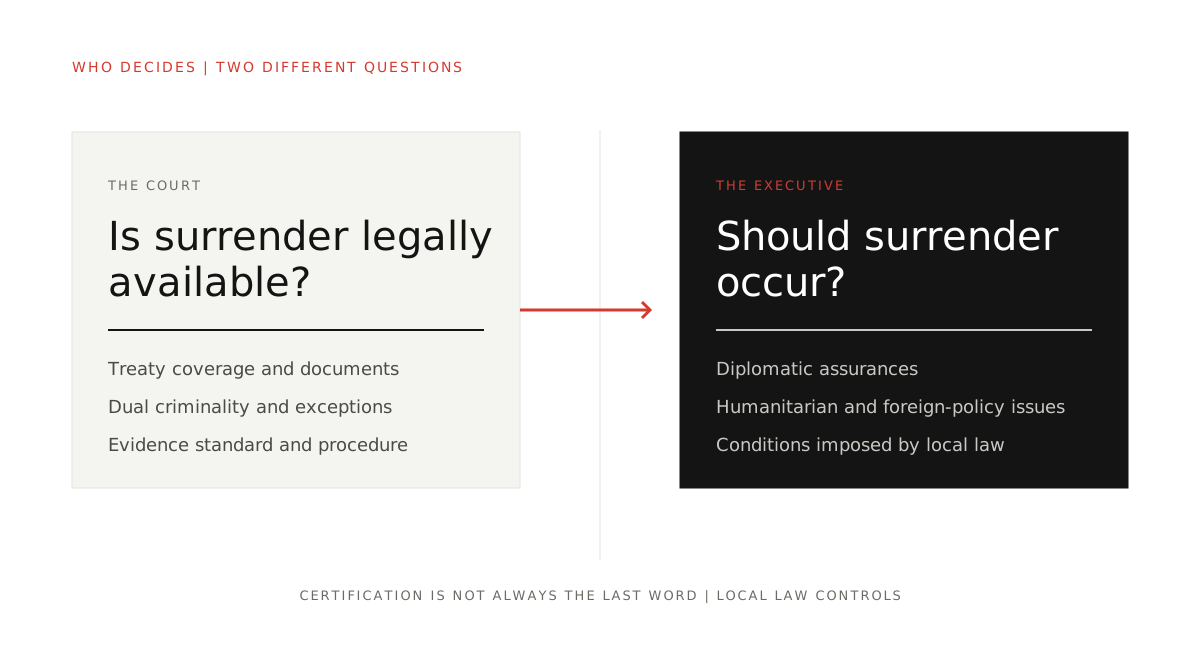
The federal Minister of Justice receives the request and may issue an authority to proceed under section 15. A superior-court judge conducts the committal hearing under section 29. If committed, the Minister personally decides surrender under sections 40-47, ordinarily within 90 days after committal subject to statutory extensions and litigation.
THE CLOCK
Deadlines are event-specific
Urgent provisional arrest is available. Under the bilateral treaty framework, discharge may follow if the extradition request is not received within 60 days after arrest; the Extradition Act separately governs provisional arrest warrants and their expiry. Exact service and filing dates control. There is no reliable official average. The statutory 90-day ministerial decision period is not a total-case deadline. Record preparation, committal proceedings, appeal, judicial review, Supreme Court leave, assurances and concurrent Canadian charges can extend the matter for years.
DOCUMENT AUDIT
Build the file before the argument
Preserve the notice or warrant, charging papers, identity records, release terms, travel documents, medical records, and every dated communication. Do not alter or delete evidence.
FOR FAMILIES COORDINATING ACROSS BORDERS
Confirm the exact legal name, detention location, medication needs, next hearing, local lawyer, and one reliable contact channel. A consulate may assist with welfare and contact; it cannot cancel the local case.
02 · THE PROCESS
How the Canada process moves.
Judicial and executive stages
The federal Minister of Justice receives the request and may issue an authority to proceed under section 15. A superior-court judge conducts the committal hearing under section 29. If committed, the Minister personally decides surrender under sections 40-47, ordinarily within 90 days after committal subject to statutory extensions and litigation.
Appeal and review
Section 49 permits appeal of committal to the provincial court of appeal (law as of right; fact or mixed grounds generally require leave). Section 57 gives that court exclusive original jurisdiction to judicially review the Minister's decision. Supreme Court of Canada review requires leave.
03 · DEFENSES
The request still has to survive the record.
ISSUE
Treaty coverage
The charged conduct, punishment threshold, documents, and identity must fit the controlling treaty and local implementing law.
ISSUE
Dual criminality
Yes. Treaty and Extradition Act section 3 generally require corresponding Canadian conduct punishable by a maximum of at least two years (subject to the relevant agreement). At the committal hearing, section 29 asks whether admissible evidence would justify committal for trial in Canada for the corresponding offense.
ISSUE
Political and protected offenses
Political offenses are excluded, with modern exclusions for specified violent and treaty crimes. Pure military offenses are excluded. Modern dual-criminality treatment does not create a categorical fiscal-offense exception. The Act also requires refusal where surrender would be unjust or oppressive or discriminatory and addresses prior jeopardy, absence convictions and limitation issues.
ISSUE
Evidence and process
The request can be tested against the treaty standard, authentication requirements, limitation rules, and procedural guarantees that apply locally.
ISSUE
Human rights and punishment
Extradition Act section 44(2) permits refusal where the conduct is death-punishable. In United States v. Burns, the Supreme Court of Canada held that, absent exceptional circumstances, constitutional principles require assurances that death will not be imposed or carried out. Section 44(1) mandates refusal where surrender would be unjust or oppressive or discriminatorily motivated.
ISSUE
Specialty and assurances
Yes. Canada generally requires that the person be prosecuted or punished only for the conduct for which surrender was granted, subject to consent and agreement exceptions.
04 · PUBLIC EXAMPLES
Recent public extradition records.
These examples come from public government records and are not presented as Spodek Law Group matters or results.
Rahsontanohstha Delormier
alien-smuggling conspiracy and smuggling resulting in death
Stephanie Square
alien-smuggling conspiracy, smuggling for profit and resulting in death
Justin David Lanoue
state child rape and felony sexual abuse of a minor
Canadian prize-notice defendant
fraudulent prize-notice mail scheme
05 · THE CHARGES
What appears in the requests.
A Red Notice is not the extradition order.
A Red Notice asks police worldwide to locate and provisionally arrest a person, subject to each country's law. It is not an international arrest warrant, and it does not replace the treaty papers or the local extradition case.
The notice, the provisional-arrest request, and the surrender proceeding are separate records. Each can carry different defects, deadlines, and remedies.
07 · THIRD-COUNTRY RISK
Transit can expose a person to another country's arrest rules, immigration powers, or provisional request. This page gives no route or evasion advice. Review the actual warrant, notice, release conditions, and jurisdictions with counsel before travel.
08 · QUESTIONS
What families and targets ask first.
IMMEDIATE EXTRADITION QUESTIONS
No. A Red Notice is a request to locate and provisionally arrest, not an international arrest warrant or a finding of extraditability. Canada's arrest law, the treaty record, and the local surrender process still control.
AUTHORITIESwww.interpol.int
It can. Border screening may expose a national warrant, INTERPOL data, immigration authority, or a provisional request under another country's law. This is not travel or evasion advice; the actual records and jurisdictions require review before travel.
AUTHORITIESwww.interpol.int
Release depends on Canada's current law, the arrest authority, flight-risk findings, and the stage of the request. No general website answer can predict it. Local counsel should address custody while U.S. counsel verifies the federal matter and request.
AUTHORITIESwww.justice.gov
Not automatically. Extradition, asylum, immigration removal, and non-refoulement are separate legal systems that may interact. The forum, protected status, alleged conduct, treaty, and current human-rights evidence determine which arguments are available.
AUTHORITIESwww.justice.gov
COUNTRY PROCEDURE
Yes. The 1971 treaty, effective in 1976, was modernized by protocols signed in 1988 and 2001.
AUTHORITIESwww.justice.govwww.govinfo.gov
Yes. Citizenship, including dual citizenship, is not a categorical bar.
AUTHORITIESwww.justice.govwww.justice.gov
The conduct must correspond to a Canadian offense meeting the treaty/Act punishment threshold; identical offense names are unnecessary.
AUTHORITIESlaws-lois.justice.gc.cawww.justice.gov
The Minister authorizes proceedings, a superior-court judge decides committal, and the Minister personally makes the surrender decision.
AUTHORITIESlaws-lois.justice.gc.ca
Yes. Section 49 permits appeal to the provincial court of appeal, with leave required for many fact or mixed-law grounds.
AUTHORITIESlaws-lois.justice.gc.ca
Yes. Section 57 assigns judicial review to the provincial court of appeal.
AUTHORITIESlaws-lois.justice.gc.ca
The Minister may refuse under section 44(2), and Supreme Court precedent ordinarily requires assurances against execution absent exceptional circumstances.
AUTHORITIESlaws-lois.justice.gc.ca
Yes. Section 44(1) requires refusal if surrender would be unjust or oppressive or the request is discriminatorily motivated or would cause discriminatory prejudice.
AUTHORITIESlaws-lois.justice.gc.ca
The bilateral framework generally uses a 60-day period, but the warrant and receipt dates in the specific proceeding control.
AUTHORITIESwww.justice.govlaws-lois.justice.gc.ca
No. It addresses the ministerial decision after committal and may be affected by extensions and appellate litigation.
AUTHORITIESlaws-lois.justice.gc.ca
09 · RESEARCH LIMITS
What the public record does not settle.
10 · SOURCES
Every material claim should have a file behind it.
11 · REGIONAL INDEX
Related country files.

WHO REVIEWS THE FIRST CALL
Start with the paper, the posture, and the first deadline.
Todd A. Spodek leads the firm's federal defense work. The team identifies the active U.S. matter, the country and custody posture, and where appropriately licensed local counsel is required. No webpage can replace review of the actual request.
Todd Spodek - biography and record →SECURE CONSULTATION REQUEST
Put the actual extradition record in front of counsel.
Tell us whether this is an inquiry, Red Notice, detention, hearing, or appeal. The intake team will identify conflicts and the right next step. Urgent custody and hearing matters should call.
212 300 5196 - urgent matters →