INTERNATIONAL EXTRADITION · CARIBBEAN
Extradition from Dominican Republic to the United States.
Convention for the Mutual Extradition of Fugitives from Justice (1909) controls the request. The old convention does not itself create a clear modern nationality bar. The arrest clock and local review path decide what happens next.

THE SHORT ANSWER
In force No official average was found. Recent releases show active cooperation, but publication usually omits arrest and decree dates. Identity disputes, old treaty offense matching, nationality, concurrent Dominican proceedings and requested assurances can affect timing.
Convention for the Mutual Extradition of Fugitives from Justice (1909)
Effective: 1910-08-02
WHAT COUNSEL CHECKS FIRST
The active paper. The country. The clock.
THE RESPONSE ROOM
What has to be established first.
FIRST HOURS
Identify the legal basis for custody
Record the arresting authority, court, case number, custody location, interpreter need, and any hearing date. Ask for counsel before discussing the foreign accusation.
WHO DECIDES
The local record controls
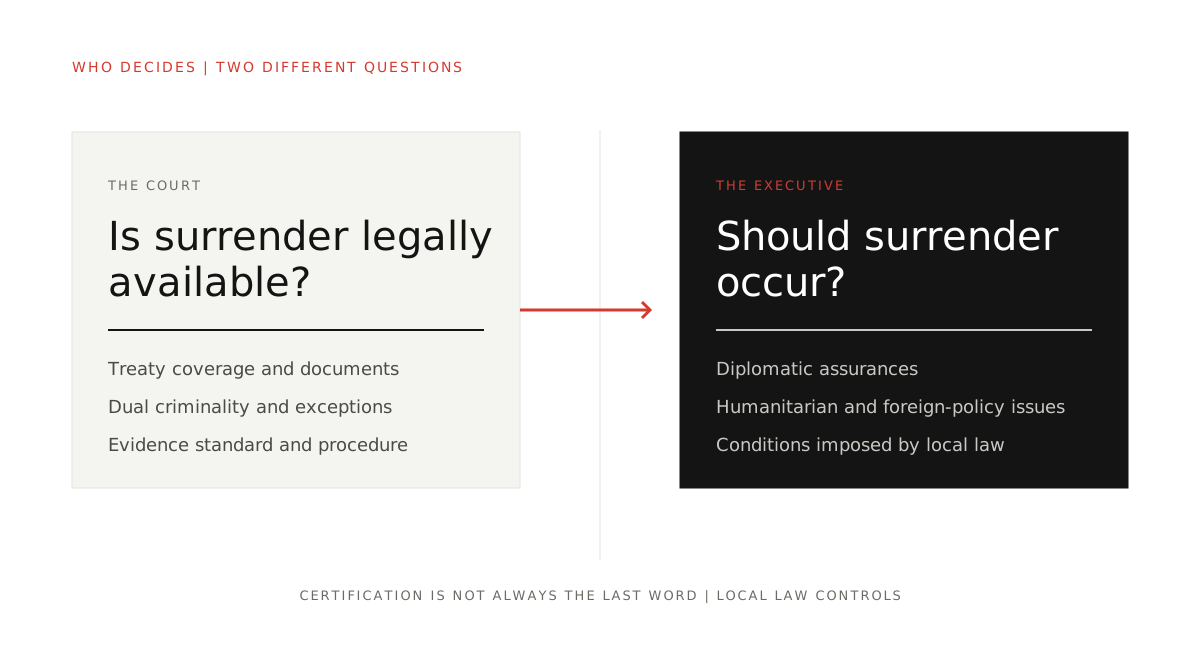
Requests proceed diplomatically and through the Dominican executive under Law 489. The Public Ministry seeks arrest and the Supreme Court of Justice conducts the hearing and issues the judicial decision or opinion required by domestic practice; the President issues the final extradition decree.
THE CLOCK
Deadlines are event-specific
The convention permits provisional detention on telegraphic or other notice of a warrant or equivalent judicial act. The text provides a two-month period for production of the formal requisition and evidence; the exact start date and interaction with current Law 489 should be verified in the arrest order. No official average was found. Recent releases show active cooperation, but publication usually omits arrest and decree dates. Identity disputes, old treaty offense matching, nationality, concurrent Dominican proceedings and requested assurances can affect timing.
DOCUMENT AUDIT
Build the file before the argument
Preserve the notice or warrant, charging papers, identity records, release terms, travel documents, medical records, and every dated communication. Do not alter or delete evidence.
FOR FAMILIES COORDINATING ACROSS BORDERS
Confirm the exact legal name, detention location, medication needs, next hearing, local lawyer, and one reliable contact channel. A consulate may assist with welfare and contact; it cannot cancel the local case.
02 · THE PROCESS
How the Dominican Republic process moves.
Judicial and executive stages
Requests proceed diplomatically and through the Dominican executive under Law 489. The Public Ministry seeks arrest and the Supreme Court of Justice conducts the hearing and issues the judicial decision or opinion required by domestic practice; the President issues the final extradition decree.
Appeal and review
The available challenge is primarily constitutional and procedural review rather than a full retrial of the U.S. charge. The exact route and deadline for reconsideration, amparo or constitutional review must be confirmed from the served Supreme Court decision and presidential decree.
03 · DEFENSES
The request still has to survive the record.
ISSUE
Treaty coverage
The charged conduct, punishment threshold, documents, and identity must fit the controlling treaty and local implementing law.
ISSUE
Dual criminality
The convention is offense-list based rather than a modern sentence-threshold treaty. The alleged conduct must fit a listed treaty category and be criminal in both states; modern offenses may require analysis by analogy to listed categories such as fraud, forgery, murder or narcotics offenses as later law and conventions permit.
ISSUE
Political and protected offenses
The convention excludes offenses of a political character and protects against surrender where the request is actually politically motivated. Purely military and fiscal offenses are not independently listed; ordinary crimes arising from the same conduct require careful list-and-dual-criminality analysis. Prior trial and limitations rules apply.
ISSUE
Evidence and process
The request can be tested against the treaty standard, authentication requirements, limitation rules, and procedural guarantees that apply locally.
ISSUE
Human rights and punishment
The Dominican Constitution prohibits the death penalty. The 1909 convention has no modern capital-punishment article, so capital exposure and assurances must be addressed under Dominican constitutional law, human-rights obligations and the executive decree. Torture, arbitrary treatment and due-process claims require case-specific review.
ISSUE
Specialty and assurances
Yes. The convention limits detention or trial after surrender to the offense for which extradition was granted, subject to the convention's stated exceptions.
04 · PUBLIC EXAMPLES
Recent public extradition records.
These examples come from public government records and are not presented as Spodek Law Group matters or results.
Ruddy Cenit-Then
conspiracy to distribute fentanyl and methamphetamine
Ezequiel Brito
heroin and fentanyl trafficking
Marco Tulio Fernandez-Rodriguez
murder, narcotics and firearms arising from an attempted robbery
Juan Rafael Parra Arias, Miguel Angel Vasquez and Jose Ismael Dilone Rodriguez
transnational grandparent-scam fraud
Rafael Ambiorix Rodriguez Guzman and Felix Samuel Reynoso Ventura
transnational grandparent-scam fraud
05 · THE CHARGES
What appears in the requests.
A Red Notice is not the extradition order.
A Red Notice asks police worldwide to locate and provisionally arrest a person, subject to each country's law. It is not an international arrest warrant, and it does not replace the treaty papers or the local extradition case.
The notice, the provisional-arrest request, and the surrender proceeding are separate records. Each can carry different defects, deadlines, and remedies.
07 · THIRD-COUNTRY RISK
Transit can expose a person to another country's arrest rules, immigration powers, or provisional request. This page gives no route or evasion advice. Review the actual warrant, notice, release conditions, and jurisdictions with counsel before travel.
08 · QUESTIONS
What families and targets ask first.
IMMEDIATE EXTRADITION QUESTIONS
No. A Red Notice is a request to locate and provisionally arrest, not an international arrest warrant or a finding of extraditability. Dominican Republic's arrest law, the treaty record, and the local surrender process still control.
AUTHORITIESwww.interpol.int
It can. Border screening may expose a national warrant, INTERPOL data, immigration authority, or a provisional request under another country's law. This is not travel or evasion advice; the actual records and jurisdictions require review before travel.
AUTHORITIESwww.interpol.int
Release depends on Dominican Republic's current law, the arrest authority, flight-risk findings, and the stage of the request. No general website answer can predict it. Local counsel should address custody while U.S. counsel verifies the federal matter and request.
AUTHORITIESwww.justice.gov
Not automatically. Extradition, asylum, immigration removal, and non-refoulement are separate legal systems that may interact. The forum, protected status, alleged conduct, treaty, and current human-rights evidence determine which arguments are available.
AUTHORITIESwww.justice.gov
COUNTRY PROCEDURE
Yes. The 1909 convention took effect when ratifications were exchanged on August 2, 1910 and remains listed by the United States.
AUTHORITIEShistory.state.govwww.govinfo.gov
No current primary source located supports that claim; the operative bilateral convention is the 1909 agreement.
AUTHORITIEShistory.state.govwww.govinfo.gov
Yes. Dominican law permits national surrender, and recent official releases document extraditions of Dominican nationals.
AUTHORITIESwww.justice.govwww.justice.gov
No. This is an old enumerated-offense treaty; the conduct must fit a treaty category and satisfy applicable domestic-law requirements.
AUTHORITIEShistory.state.gov
Yes. The convention permits provisional detention before the full papers arrive and states a two-month production period.
AUTHORITIEShistory.state.gov
Domestic practice includes a Supreme Court phase followed by a final presidential extradition decree.
AUTHORITIESwww.consultoria.gov.do
Yes. The convention excludes political offenses and requests actually made for political purposes.
AUTHORITIEShistory.state.gov
The Dominican Constitution prohibits death, but the old convention lacks a modern death-penalty clause. Required assurances must be verified in the live constitutional and executive record.
AUTHORITIESwww.consultoria.gov.do
The convention generally limits detention and trial to the offense for which extradition was granted, subject to its exceptions.
AUTHORITIEShistory.state.gov
No official average was located. Published DOJ case summaries rarely state all Dominican arrest, court and decree dates.
AUTHORITIESwww.justice.gov
09 · RESEARCH LIMITS
What the public record does not settle.
10 · SOURCES
Every material claim should have a file behind it.
11 · REGIONAL INDEX
Related country files.

WHO REVIEWS THE FIRST CALL
Start with the paper, the posture, and the first deadline.
Todd A. Spodek leads the firm's federal defense work. The team identifies the active U.S. matter, the country and custody posture, and where appropriately licensed local counsel is required. No webpage can replace review of the actual request.
Todd Spodek - biography and record →SECURE CONSULTATION REQUEST
Put the actual extradition record in front of counsel.
Tell us whether this is an inquiry, Red Notice, detention, hearing, or appeal. The intake team will identify conflicts and the right next step. Urgent custody and hearing matters should call.
212 300 5196 - urgent matters →