INTERNATIONAL EXTRADITION · CARIBBEAN
Extradition from Jamaica to the United States.
Extradition Treaty between the United States and Jamaica (1983) controls the request. Article VII says neither party is bound to surrender its own nationals, but the requested state's executive may surrender them if domestic law permits. The arrest clock and local review path decide what happens next.

THE SHORT ANSWER
In force No official average is reliable. The 60-day provisional-arrest period is a document-receipt deadline, not a final surrender deadline. Consent can shorten proceedings; evidentiary committal issues, habeas corpus and appeals, ministerial review, local proceedings, assurances, competing requests and transfer logistics can extend a contested case substantially.
Extradition Treaty between the United States and Jamaica (1983)
Effective: 1991-07-07
WHAT COUNSEL CHECKS FIRST
The active paper. The country. The clock.
THE RESPONSE ROOM
What has to be established first.
FIRST HOURS
Identify the legal basis for custody
Record the arresting authority, court, case number, custody location, interpreter need, and any hearing date. Ask for counsel before discussing the foreign accusation.
WHO DECIDES
The local record controls
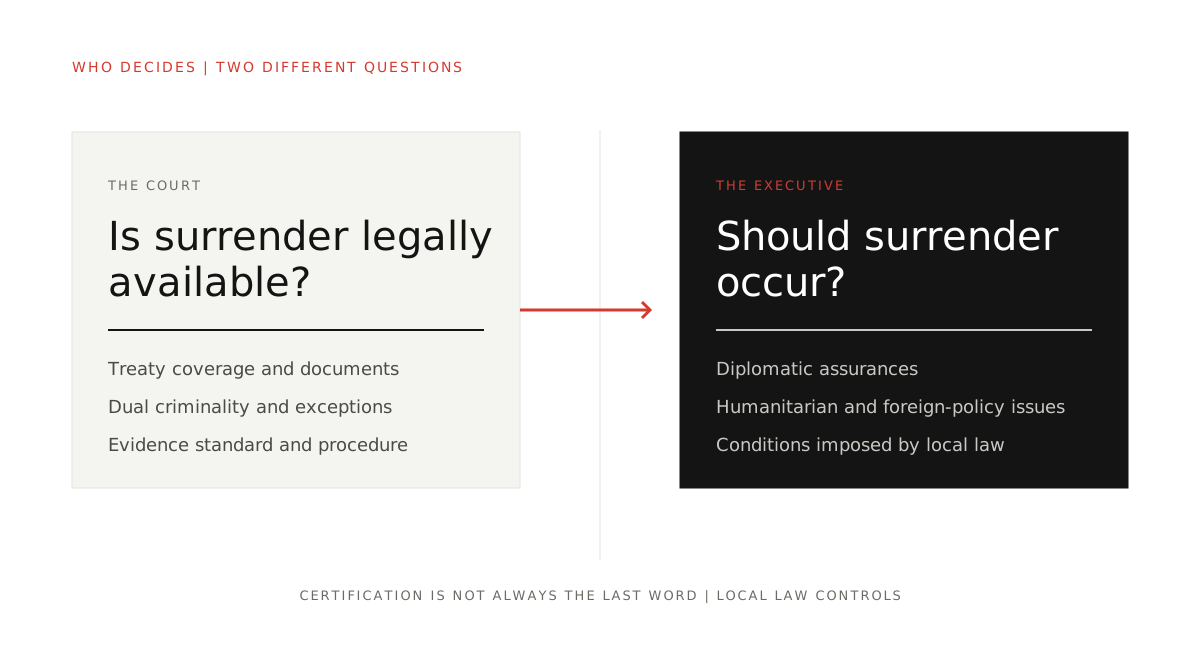
Under Jamaica's Extradition Act, the responsible Minister issues an authority to proceed for an approved foreign-state request. A parish-court judicial officer handles the warrant and committal hearing and tests whether the treaty/statutory offense and evidence requirements are met. After committal and expiration or resolution of habeas corpus proceedings, the Minister decides whether to order surrender, subject to statutory and treaty restrictions.
THE CLOCK
Deadlines are event-specific
Article X permits urgent provisional arrest through diplomatic channels or directly between the U.S. Department of Justice and Jamaica's responsible minister. The person must be discharged after 60 days from arrest if the executive authority has not received the formal request and Article VIII documents; a later completed request may still proceed. No official average is reliable. The 60-day provisional-arrest period is a document-receipt deadline, not a final surrender deadline. Consent can shorten proceedings; evidentiary committal issues, habeas corpus and appeals, ministerial review, local proceedings, assurances, competing requests and transfer logistics can extend a contested case substantially.
DOCUMENT AUDIT
Build the file before the argument
Preserve the notice or warrant, charging papers, identity records, release terms, travel documents, medical records, and every dated communication. Do not alter or delete evidence.
FOR FAMILIES COORDINATING ACROSS BORDERS
Confirm the exact legal name, detention location, medication needs, next hearing, local lawyer, and one reliable contact channel. A consulate may assist with welfare and contact; it cannot cancel the local case.
02 · THE PROCESS
How the Jamaica process moves.
Judicial and executive stages
Under Jamaica's Extradition Act, the responsible Minister issues an authority to proceed for an approved foreign-state request. A parish-court judicial officer handles the warrant and committal hearing and tests whether the treaty/statutory offense and evidence requirements are met. After committal and expiration or resolution of habeas corpus proceedings, the Minister decides whether to order surrender, subject to statutory and treaty restrictions.
Appeal and review
Section 11 provides an application for habeas corpus after committal. Review may proceed through Jamaica's superior appellate courts under the Constitution and applicable appellate legislation, potentially including final review by the Judicial Committee of the Privy Council where jurisdiction and permission requirements are met. Exact route and deadlines must be checked against the current Act and rules.
03 · DEFENSES
The request still has to survive the record.
ISSUE
Treaty coverage
The charged conduct, punishment threshold, documents, and identity must fit the controlling treaty and local implementing law.
ISSUE
Dual criminality
Yes. Article II covers offenses punishable under both states' laws by more than one year, including attempt, conspiracy, aiding, counseling, procuring, accessory liability and obstruction of apprehension/prosecution. Categories and terminology need not match, and specified U.S. interstate-commerce or mail jurisdictional elements are disregarded.
ISSUE
Political and protected offenses
Article III excludes political offenses, politically purposed requests and discriminatory prosecution or punishment; treaty-based extradite-or-prosecute offenses are excepted from that bar. Pure military-law offenses may be refused. There is no categorical fiscal-offense exception, so tax or customs conduct is assessed under dual criminality. Article VI addresses requesting-state limitation periods and Article IV says a local non-prosecution decision does not itself bar extradition.
ISSUE
Evidence and process
The request can be tested against the treaty standard, authentication requirements, limitation rules, and procedural guarantees that apply locally.
ISSUE
Human rights and punishment
Article V permits Jamaica's executive authority to refuse where the requesting state permits death for the offense and Jamaica does not, while requiring due and sympathetic consideration of an assurance that death will not be carried out. Jamaica retains capital punishment in law for a narrow class of murder but has not executed since 1988; the offense comparison and assurance therefore require case-specific review. Constitutional due process, detention and fair-hearing rights also apply.
ISSUE
Specialty and assurances
Yes. Article XIV limits detention, trial and punishment to the offense for which extradition was granted, qualifying lesser offenses disclosed by the committal facts, post-surrender offenses, or offenses consented to by the requested state; it includes an opportunity-to-leave exception.
04 · PUBLIC EXAMPLES
Recent public extradition records.
These examples come from public government records and are not presented as Spodek Law Group matters or results.
Dwayne Anderson
wire fraud in a long-running sweepstakes scheme
Antony Linton Stewart
mail/wire fraud and money laundering conspiracy in a lottery scheme
Damone D. Oakley
mail and wire fraud in a sweepstakes scheme
05 · THE CHARGES
What appears in the requests.
A Red Notice is not the extradition order.
A Red Notice asks police worldwide to locate and provisionally arrest a person, subject to each country's law. It is not an international arrest warrant, and it does not replace the treaty papers or the local extradition case.
The notice, the provisional-arrest request, and the surrender proceeding are separate records. Each can carry different defects, deadlines, and remedies.
07 · THIRD-COUNTRY RISK
Transit can expose a person to another country's arrest rules, immigration powers, or provisional request. This page gives no route or evasion advice. Review the actual warrant, notice, release conditions, and jurisdictions with counsel before travel.
08 · QUESTIONS
What families and targets ask first.
IMMEDIATE EXTRADITION QUESTIONS
No. A Red Notice is a request to locate and provisionally arrest, not an international arrest warrant or a finding of extraditability. Jamaica's arrest law, the treaty record, and the local surrender process still control.
AUTHORITIESwww.interpol.int
It can. Border screening may expose a national warrant, INTERPOL data, immigration authority, or a provisional request under another country's law. This is not travel or evasion advice; the actual records and jurisdictions require review before travel.
AUTHORITIESwww.interpol.int
Release depends on Jamaica's current law, the arrest authority, flight-risk findings, and the stage of the request. No general website answer can predict it. Local counsel should address custody while U.S. counsel verifies the federal matter and request.
AUTHORITIESwww.justice.gov
Not automatically. Extradition, asylum, immigration removal, and non-refoulement are separate legal systems that may interact. The forum, protected status, alleged conduct, treaty, and current human-rights evidence determine which arguments are available.
AUTHORITIESwww.justice.gov
COUNTRY PROCEDURE
Yes. It was signed June 14, 1983 and entered into force July 7, 1991.
AUTHORITIES2017-2021.state.govwww.congress.gov
Yes, in the executive authority's discretion if Jamaican law permits. The treaty does not compel surrender of a sole Jamaican national, but dual U.S.-Jamaican nationality cannot be the ground for refusal.
AUTHORITIES2017-2021.state.gov
Conduct must generally be punishable under both countries' laws by more than one year; offense names need not match, and listed participation forms also qualify.
AUTHORITIES2017-2021.state.govlaws.moj.gov.jm
Yes. Article X permits urgent provisional arrest, but release is required after 60 days if the formal request and required documents have not reached the executive authority.
AUTHORITIES2017-2021.state.gov
The responsible Minister authorizes proceedings, a judicial officer decides committal, and the Minister makes the surrender order after judicial review opportunities and subject to treaty/statutory bars.
AUTHORITIESlaws.moj.gov.jmlaws.moj.gov.jm
Yes. The Act expressly provides habeas corpus after committal, with further appellate review governed by current constitutional and appellate rules.
AUTHORITIESlaws.moj.gov.jmlaws.moj.gov.jm
Political offenses and discriminatory or politically purposed requests are barred, subject to treaty-convention exceptions; purely military-law offenses may be refused.
AUTHORITIES2017-2021.state.gov
Article V permits refusal when death is available in the requesting but not requested state for the offense and directs consideration of an assurance that death will not be carried out.
AUTHORITIES2017-2021.state.gov
Only within Article XIV specialty exceptions, such as a qualifying lesser offense, post-surrender conduct, Jamaica's consent or the opportunity-to-leave exception.
AUTHORITIES2017-2021.state.gov
No official average controls. The 60-day provisional-arrest period concerns receipt of papers; committal, habeas corpus, appeals, ministerial decision and assurances determine total time.
AUTHORITIESlaws.moj.gov.jmwww.justice.gov
09 · RESEARCH LIMITS
What the public record does not settle.
10 · SOURCES
Every material claim should have a file behind it.
11 · REGIONAL INDEX
Related country files.

WHO REVIEWS THE FIRST CALL
Start with the paper, the posture, and the first deadline.
Todd A. Spodek leads the firm's federal defense work. The team identifies the active U.S. matter, the country and custody posture, and where appropriately licensed local counsel is required. No webpage can replace review of the actual request.
Todd Spodek - biography and record →SECURE CONSULTATION REQUEST
Put the actual extradition record in front of counsel.
Tell us whether this is an inquiry, Red Notice, detention, hearing, or appeal. The intake team will identify conflicts and the right next step. Urgent custody and hearing matters should call.
212 300 5196 - urgent matters →