NO TREATY · NOT NO RISK
Countries without a U.S. extradition treaty.
No treaty is a legal fact, not a promise of safety. Deportation, expulsion, immigration removal, third-country arrest, and diplomatic cooperation can still move a person into U.S. custody.

WHAT COUNSEL CHECKS FIRST
The active paper. The country. The clock.
START WITH THE POSTURE
Which file is actually open.
02 · THE FLOW
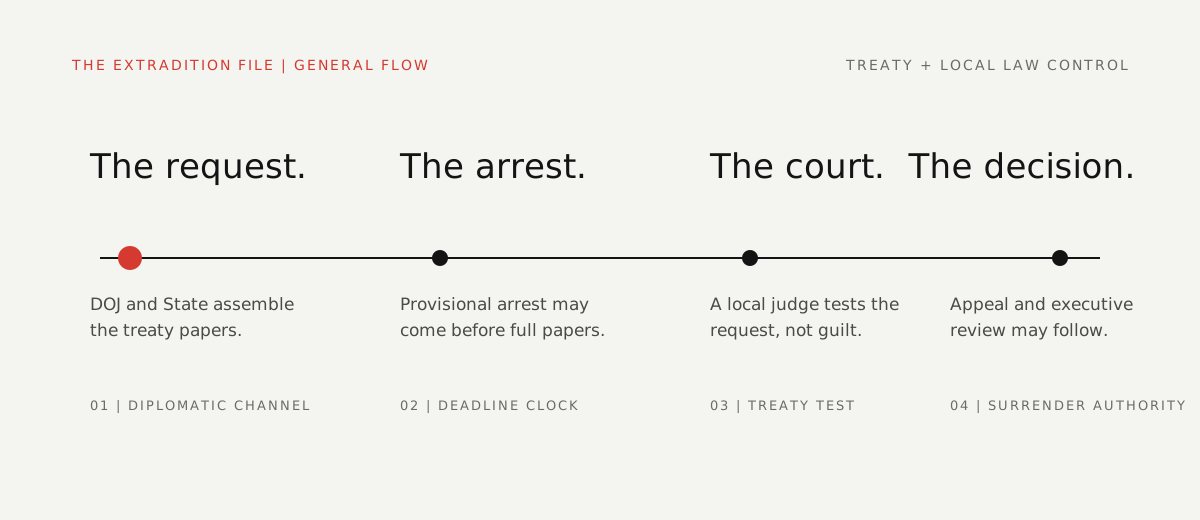
One request. Several separate decisions.
Verify the legal relationship
Check Treaties in Force, treaty actions, the § 3181 notes, successor-state and territorial coverage, and any applicable multilateral instrument. A signed or pending treaty is not necessarily in force.
Identify direction and custody country
The rules for a U.S. request abroad differ from a foreign request to the United States. The requested state's domestic law is central.
Identify the actual authority
Distinguish extradition, domestic surrender/comity, provisional arrest, immigration detention, deportation, expulsion, local prosecution, a national warrant, and an INTERPOL alert.
Test procedural and human-rights protections
Each route has different hearing rights, detention rules, non-refoulement protections, appellate review, and assurance practice. A government cannot erase those distinctions by changing labels.
03 · THE ISSUES
Where the case can turn.
ON THE RECORD
What “no treaty” actually means
For surrender from the United States under 18 U.S.C. § 3184, a treaty is generally required. Section 3181(b) creates a narrow comity exception for a non-U.S. citizen, non-national, non-permanent-resident accused of a foreign crime of violence against a U.S. national when the Attorney General makes specified certifications. The rule in the country where a person is found may be different: State says some countries extradite as a matter of comity under domestic law without a treaty.
ON THE RECORD
Treaty absence is not a bar to every lawful transfer
A requested country may surrender under its own domestic law or comity. Immigration authorities may independently deport or expel a non-national when local law permits; that is legally distinct from extradition. A country may prosecute conduct domestically, including under nationality or extraterritorial-jurisdiction rules. A Red Notice or diffusion can circulate even without a treaty, and a country may treat it as a basis to locate or arrest under local law. Travel to or through a third country with an applicable treaty may create a different legal route. Passport or immigration action may affect lawful residence and movement. A multilateral convention may create prosecute-or-extradite obligations for a specified offense, but State says the United States does not, as a matter of practice, extradite solely on such a convention to a state with which it has no bilateral treaty.
ON THE RECORD
Alternative mechanisms are government powers, not self-help instructions
The DOJ manual lists deportation, expulsion, other lawful return, Red Notices, passport revocation, and foreign prosecution among possible alternatives. It also describes tightly controlled lures and extraordinary returns, but warns of sovereignty and criminal-law concerns and requires high-level approval. This page does not advise private actors or readers to arrange, resist, or exploit any of those mechanisms.
ON THE RECORD
A country without a U.S. treaty asking the United States for surrender
The ordinary § 3184 treaty process is generally unavailable. The narrow § 3181(b) exception is not a general comity power: it excludes U.S. citizens, nationals, and permanent residents and is limited to qualifying violent crimes against U.S. nationals with written Attorney General certification. Separate U.S. immigration proceedings, domestic prosecution, or transfer to an international tribunal arise under different authority and protections.
04 · THE EXHIBITS
Claims tested against the rule.
Treaty and non-treaty routes are not interchangeable.
| Route | Basic authority | Key correction |
|---|---|---|
| Treaty extradition | Treaty plus domestic implementing law | A court or competent authority tests treaty conditions; surrender may include an executive decision. |
| Comity / domestic surrender | Requested state's domestic law | Some states permit it without a treaty; others do not. |
| Deportation or expulsion | Immigration or public-order law | It is not automatically available and does not become extradition merely because another state requested cooperation. |
| Foreign prosecution | Requested state's criminal jurisdiction | The person may face proceedings where found rather than physical return. |
| INTERPOL notice or diffusion | International police communication plus national law | The alert is not itself an international arrest warrant. |
| Multilateral convention | Offense-specific convention and domestic law | Coverage is offense- and state-specific; U.S. practice does not treat a convention alone as a general substitute for a bilateral treaty. |
| Third-country extradition | Third country's treaty and law | Status can change when a person crosses a border; no country is a guaranteed safe harbor. |
Selected notable jurisdictions without an identified bilateral U.S. extradition agreement.
| Jurisdiction | Region | Status checked | Practical/legal caution |
|---|---|---|---|
| Afghanistan | South/Central Asia | No bilateral agreement identified | Local authority, recognition, security, immigration, and third-country transit issues can dominate. |
| Algeria | North Africa | No bilateral agreement identified | Domestic law and diplomatic cooperation require case-specific verification. |
| Bahrain | Gulf | No bilateral agreement identified | Other security, immigration, and judicial-assistance cooperation should not be confused with extradition. |
| Cambodia | Southeast Asia | No bilateral agreement identified | Domestic expulsion, immigration law, and regional travel can change exposure. |
| China (People's Republic of China) | East Asia | No bilateral agreement identified | Hong Kong and Macao are legally distinct for treaty-history analysis; current suspension and territorial status must be separately checked. |
| Indonesia | Southeast Asia | No bilateral agreement identified | Domestic law, immigration removal, police cooperation, and third-country arrest remain possible. |
| Kuwait | Gulf | No bilateral agreement identified | Do not infer non-cooperation from treaty absence. |
| Laos | Southeast Asia | No bilateral agreement identified | Domestic law and neighboring-state transit are separate variables. |
| Lebanon | Middle East | No bilateral agreement identified | Domestic nationality rules and local proceedings require current local-law advice. |
| Libya | North Africa | No bilateral agreement identified | Government recognition, security, and lawful authority are case-specific. |
| Mongolia | East/Central Asia | No bilateral agreement identified | Police and immigration cooperation are separate from treaty extradition. |
| Nepal | South Asia | No bilateral agreement identified | Domestic surrender or immigration mechanisms require current verification. |
| Qatar | Gulf | No bilateral agreement identified | Domestic-law cooperation and immigration action remain distinct possibilities. |
| Russia | Europe/Eurasia | No extradition agreement identified; a separate U.S.-Russia MLAT entered into force in 2002 | An MLAT concerns evidence and legal assistance; it is not an extradition treaty. |
| Saudi Arabia | Gulf | No bilateral agreement identified | Diplomatic, immigration, domestic-prosecution, and security cooperation are separate questions. |
| Syria | Middle East | No bilateral agreement identified | Recognition, sanctions, security, and local-law questions require specialized review. |
| United Arab Emirates | Gulf | No bilateral agreement identified | Deportation, expulsion, domestic enforcement, and third-country travel can still matter. |
| Vietnam | Southeast Asia | No bilateral agreement identified | Law-enforcement and immigration cooperation should be evaluated independently. |
| Yemen | Middle East | No bilateral agreement identified | Authority, security, and territorial control make country-level generalization especially unreliable. |
THE DISTINCTION
Treaty is not outcome. Arrest is not surrender.
Each stage has its own authority, record, deadline, and available challenge. Treating them as one event is how defenses get missed.
Put the actual documents in front of counsel →05 · QUESTIONS
The answers people need before the next border.
PANIC
Yes. A Red Notice is a police-cooperation request based on a national warrant or court order, not proof that extradition is legally available. The receiving country decides what action its law permits.
AUTHORITIESS5
Generally the § 3184 process requires a treaty. Section 3181(b) provides a narrow exception for certain non-U.S. persons accused of violent crimes against U.S. nationals after written Attorney General certification. Other transfers may arise under separate immigration, tribunal, or statutory authority.
FIGHT
Potentially. DOJ identifies foreign prosecution as an alternative when extradition is unavailable, especially where the country of refuge can prosecute its national or exercises jurisdiction over the conduct. Availability and evidentiary transfer are country- and offense-specific.
AUTHORITIESS4
Sometimes a convention contains offense-specific prosecute-or-extradite obligations and some states use it as a surrender basis. State's FAM says that, as a matter of U.S. practice, the United States does not extradite solely on a multilateral convention to a state with which it has no bilateral treaty.
AUTHORITIESS2
Yes. A pending national warrant or INTERPOL alert may remain active, and a later border crossing can place the person under a different treaty and domestic-law regime.
AUTHORITIESS5
No. Consent or waiver can shorten proceedings but may affect specialty, immigration, detention, charging, and sentencing positions. It should be evaluated with counsel in every affected jurisdiction.
AUTHORITIESS4
06 · SOURCES
Primary authority first.
SECURE CONSULTATION REQUEST
Put the actual international record in front of counsel.
Tell us whether this is an inquiry, Red Notice, detention, hearing, or appeal. The intake team will identify conflicts and the right next step. Urgent custody and hearing matters should call.
212 300 5196 - urgent matters →