





Free Consultations & We're Available 24/7

Call for a free consultation

212-300-5196

FEDERAL CRIMINAL LAWYERS

✓Nationwide Service. A+ Results.
✓Over 50 Years of Experience
✓Available 24/7
✓We Get Cases Dismissed

Talk To An Attorney

Service Oriented Law Firm

WE'RE A BOUTIQUE LAW FIRM.

Over 50 Years Experience

TRUST 50 YEARS OF EXPERIENCE.

Multiple Offices

WE SERVICE CLIENTS NATIONWIDE.

NJ CRIMINAL DEFENSE ATTORNEYS

  • We offer payment plans, unlike other law firms, in order to make it so you can afford our services.
  • 99% of the criminal defense cases we handle end up with a better outcome.
  • We have over 50 years of experience handling criminal defense cases successfully.

99% Of Cases We Handle
End With a Better Outcome

View more case results


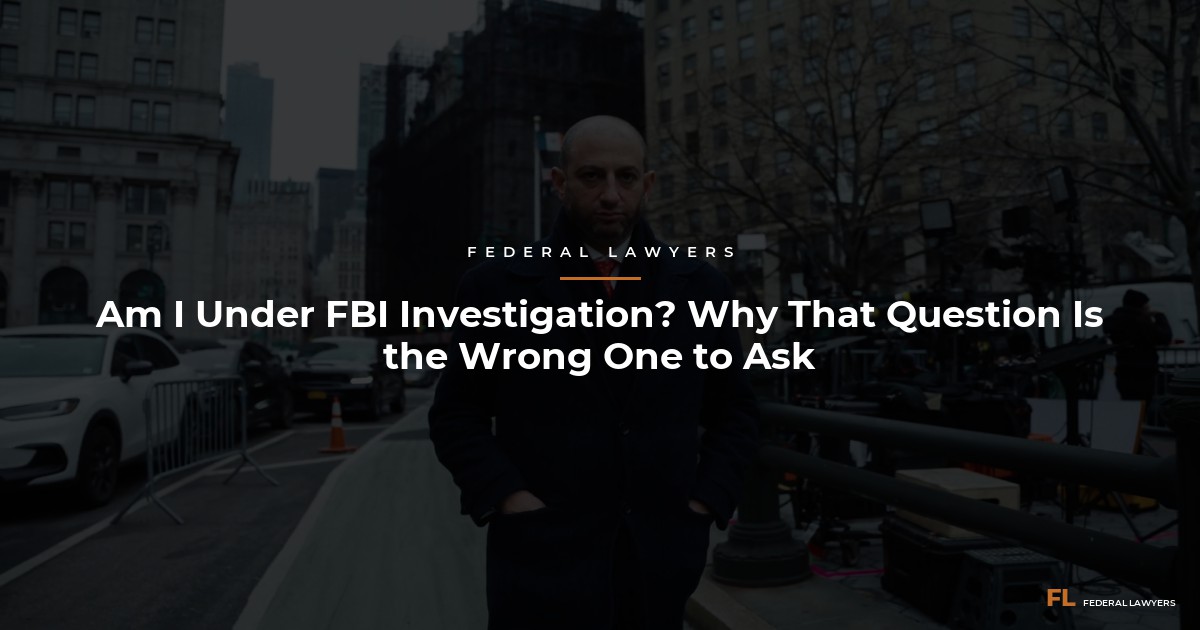
Am I Under FBI Investigation? Why That Question Is the Wrong One to Ask

Am I Under FBI Investigation? Why That Question Is the Wrong One to Ask

You typed those words into a search engine because something feels wrong. Maybe an FBI agent left a business card at your door. Maybe your bank froze your account without explanation. Maybe a coworker mentioned that someone was asking questions about you. The anxiety driving your search is real. The fear keeping you awake at night is legitimate. But the question you’re asking – “Am I under FBI investigation?” – is designed to have no answer. You’re seeking certainty that the system is built to deny you.

Welcome to Spodek Law Group. Our goal is to help you understand why this question has no answer – and more importantly, to redirect your attention to the question that actually matters. Something specific triggered your search. Something happened that made you type those words into Google at 2 AM. That trigger is real. That trigger is actionable. The investigation status you’re trying to confirm is probably unknowable, possibly for years. But the anxiety driving your search isn’t irrational – it’s a signal. And that signal is telling you to protect yourself NOW, not to spend weeks trying to answer a question the government has designed to be unanswerable.

That’s the reality that breaks everyone’s expectations. You want a yes or no. You want certainty. You want someone to tell you definitively whether federal agents are building a case against you. The federal criminal justice system doesn’t work that way. Investigations can run for years without the target ever knowing. Grand jury proceedings are secret by law. The FBI has no obligation to inform you that you’re under investigation – and they almost never do. The question you’re asking is a trap. It keeps you focused on something unknowable while you ignore the thing you can actually control: your response to whatever triggered this fear in the first place.

The Question That Has No Answer: Why “Am I Under FBI Investigation” Is a Trap

Heres the inversion that changes everything about how you should think about this situation. Your asking wheather your under investigation. Thats the wrong question. The question you should be asking is: what triggered this fear, and what should I do about it regardless of investigation status?

Think about what your actualy trying to accomplish. You want to know if your under investigation so you can decide how to respond. But heres the problem – the response you should take is the SAME wheather investigation exists or not. If your under investigation, you should hire an attorney, preserve documents, stop talking to people about your concerns, and prepare for the possibility of charges. If your NOT under investigation but something made you worried enough to search, you should ALSO hire an attorney, preserve documents, stop talking to people, and prepare. The answer to the investigation question dosent change what you should do.

OK so lets think about why this question is structuraly unanswerable. The FBI has no legal obligation to tell you that your under investigation. Grand jury proceedings are secret – witnesses who testify cannot reveal there testimony. Your bank can freeze your accounts without explaining why. Your coworkers can be interviewed and instructed not to discuss it with you. The entire system is designed to operate invisibly until prosecutors are ready to move. Trying to confirm investigation status is like trying to see whats behind a wall by staring at it harder. The wall is designed to block your view.

Stop asking “Am I under investigation?” Start asking “What triggered this fear, and what should I do about it regardless of investigation status?”

And heres what makes this even more frustrating. Even if you hire an attorney, even if that attorney contacts the U.S. Attorney’s office directly, prosecutors arnt required to disclose anything. They might tell your lawyer your a “target.” They might tell your lawyer your a “subject.” They might tell your lawyer absolutley nothing. The certainty your seeking simply dosent exist in this system. The question your asking was designed by the government to be unanswerable – and every hour you spend trying to answer it is an hour you could spend protecting yourself.

What Actually Triggered Your Search? That’s the Real Data Point

Something specific made you search. That thing is real. That thing is the actual data point you should focus on – not the unknowable investigation status.

Maybe an FBI agent knocked on your door. Maybe they left a business card asking you to call. Maybe your bank suddenly froze your accounts or asked strange questions about your transactions. Maybe a coworker started acting weird around you, avoiding eye contact, changing subjects when you approach. Maybe a family member mentioned that someone was asking questions about you. Maybe you recieved a subpoena. Maybe a business partner told you federal agents visited there office.

Whatever triggered your search – that trigger is REAL. It happened. And unlike the question “Am I under investigation,” the trigger can be analyzed and responded to. The trigger tells you something meaningful about your situation. An FBI business card at your door means agents want to talk to you – thats actionable information. A frozen bank account means a financial institution flagged something – thats actionable. A coworker acting strange after potentially being interviewed – thats a data point.

Todd Spodek has spoken with hundreds of people asking “Am I under investigation?” In almost every case, the conversation eventualy reveals what actualy triggered there search. And that trigger – whatever it is – provides more useful information then any attempt to confirm investigation status ever could.

Heres the hidden connection nobody explains. Your anxiety isnt irrational. Something happened that your brain interpreted as a threat signal. That interpretation is probably correct. Your subconscious noticed something wrong – an interaction that felt off, a document that seemed strange, a pattern that didnt make sense. The anxiety your experiencing is your brain telling you to pay attention. Listen to it. But listen by focusing on the trigger, not by chasing the unanswerable investigation question.
The Reasonable Suspicion Standard: How FBI Investigations Actually Begin

Heres the system revelation that explains why so many people end up under FBI investigation without realizing it. The threshold for opening a federal investigation is far lower then most people imagine.

The FBI can open whats called a “preliminary investigation” based on “reasonable suspicion” that criminal activity may be occuring. Thats not probable cause. Thats not evidence beyond a reasonable doubt. Thats reasonable suspicion – a much lower standard that can be triggered by a tip, a suspicious activity report from your bank, an association with someone already under investigation, or even data analytics flagging unusual patterns.

OK so think about what this means. Your bank files a Suspicious Activity Report (SAR) because your cash deposits exceeded there threshold, or because your wire transfers seemed unusual, or because there compliance software flagged something automatically. You dont know the SAR was filed – banks are legaly prohibited from telling you. That SAR goes to FinCEN. Patterns get flagged. Information gets shared with the FBI. And an investigation begins without you having any idea.

Or consider association-based investigations. Your business partner is under investigation for something you knew nothing about. Agents start reviewing records – and they see your name on documents, your signature on contracts, your presence in meetings. Now your potentially a “subject” in an investigation that has nothing to do with anything YOU did. You become a person of interest because of who you associated with.

The reasonable suspicion standard means investigations can begin from tips, financial flags, or associations – often without any action on your part.

Healthcare fraud investigations often start from data analytics. The government runs algorithms on Medicare billing data looking for statistical outliers. If your medical practice bills more of a certain procedure then average, if your patient demographics dont match your billing patterns, if anything about your numbers looks unusual – that can trigger investigation. No tip required. No whistleblower. Just software flagging patterns.

This is why the question “Am I under investigation?” is so dangerous to focus on. Investigation can begin at any time, for reasons you cant predict, based on thresholds you cant see. The reasonable suspicion standard is LOW. And once investigation begins, you wont know about it until the FBI decides you should.

Why Your Anxiety Isn’t Paranoia: Understanding the Investigation Timeline

Heres the uncomfortable truth about FBI investigation timelines that most people dont understand until its to late. Federal investigations run for YEARS before any visible sign appears. The average white collar investigation takes one to three years. Some take five years or longer. During that entire time, agents are gathering evidence, interviewing witnesses, subpoenaing records, building there case – and you have no idea its happening.

Think about what that means for your situation. The thing that triggered your search – the agent’s business card, the frozen account, the weird coworker interaction – that might be a sign of an investigation thats been running for two years already. You just noticed something NOW. But the investigation might have started in 2022.

The FBI interviews witnesses BEFORE they interview targets. That means everyone around you – coworkers, business partners, accountants, maybe even family members – might already know about the investigation while your still trying to figure out if one exists. There acting strange because they were interviewed weeks or months ago, instructed not to discuss it with you. Your noticing something wrong because your perceptive. But what your noticing is a late-stage indicator, not an early warning.

At Spodek Law Group, we understand why this timeline creates such intense anxiety. You feel like something is wrong but you cant confirm it. People around you are acting different but wont explain why. Your left in a state of uncertainty that can last for years. This uncertainty itself causes measurable psychological harm – anxiety disorders, depression, PTSD-like symptoms. The stress of not knowing is itself destructive.

And heres the consequence cascade that makes this worse. Your anxiety tells you to DO something. To investigate. To ask questions. To figure out whats happening. But every action you take in response to that anxiety creates more evidence. The questions you ask become testimony from the people you asked. Your Google searches become a digital footprint that can be subpoenaed. Your attempts to understand what happened get characterized as “consciousness of guilt” – evidence that you knew something was wrong.

The Consequence of Seeking Certainty: How Your Search Creates Evidence

The search for answers is itself the trap. Every method you might use to determine wheather your under investigation creates documentation that becomes part of the case against you.

Your Google searches are subpoenable. Right now, your search history includes terms like “am I under FBI investigation” and “signs of federal investigation” and whatever else brought you to this article. If prosecutors decide to subpoena your digital records, those searches become evidence. They get characterized as consciousness of guilt – proof that you suspected something was wrong and were trying to stay ahead of investigators.

Your conversations become witnesses. When you talk to your spouse, your best friend, your therapist, your business partner about your concerns – every one of those people becomes a potential witness. They can be subpoenaed to testify about what you told them. The conversation your having right now, processing your fears with someone you trust, could become grand jury testimony.

Your inquiries create documentation. If you call the FBI agent who left a business card, that call gets documented. Your questions reveal what your worried about. Your explanations become statements that can be used against you. Even declining to talk is noted – though silence is far better then talking.

Your FOIA requests become evidence. You might think the Freedom of Information Act will tell you if your under investigation. It wont. FOIA has explicit exclusions for ongoing criminal investigations – the FBI can legally respond “no records exist” while there activley building a case against you. But your FOIA request gets documented. It shows you were concerned enough to file. That concern becomes evidence.

Heres the cruel irony. Your trying to protect yourself by understanding your situation. But every method of understanding your situation creates more evidence. The search for certainty makes your situation worse. The anxiety driving you to investigate becomes fuel for prosecution.

What You Should Do Instead of Trying to Find Out

Stop trying to confirm wheather your under investigation. Start taking protective action regardless of investigation status.

Step 1: Focus on what triggered your search. Something specific happened. An agent’s card. A frozen account. A strange interaction. That trigger is your real data point. Write it down. Understand exactly what happened. Thats the information that matters – not the unknowable investigation status.

Step 2: Consult a federal criminal defense attorney immediately. Not a business lawyer. Not your divorce attorney. A federal criminal defense attorney who handles FBI investigations. Your attorney can make inquiries that you cannot make. They can contact the U.S. Attorney’s office on your behalf. They can communicate in ways that are protected by privilege. What you say to your attorney stays with your attorney.

Step 3: Stop talking to everyone else. Every person you discuss your concerns with becomes a potential witness. Your spouse, your best friend, your therapist, your accountant – they can all be compelled to testify about what you told them. Stop creating witnesses. The only person you should be discussing this with is your attorney.

Step 4: Preserve every document. Whether or not investigation exists, document preservation is critical. Emails, bank statements, tax returns, contracts, text messages – everything potentially relevant needs to be preserved. If investigation exists, destruction is obstruction. If investigation dosent exist, preservation costs nothing.

Step 5: Prepare as if investigation exists. This is the strategic inversion that protects you. You may never confirm wheather the FBI has a file on you. You dont need confirmation to respond appropriatley. Take protective action based on the possibility, not on certainty that may never come.

Heres something else most people dont understand about the psychology of this situation. The anxiety your experiencing isnt going to go away just because you confirm or deny investigation status. If you confirm investigation exists, your anxiety increases – now you know for certain that federal agents are building a case. If you somehow confirm investigation dosent exist, your anxiety might decrease temporarily – but then what triggered your search remains unexplained. You’ll keep wondering. The certainty your seeking wont give you peace either way.

And heres the final truth about attorney involvement that changes everything. When you hire a federal criminal defense attorney, that attorney can make inquiries to the U.S. Attorney’s office that you cannot make. They can ask about your status. They can learn if your a witness, subject, or target. They can sometimes obtain information about the general nature of allegations. But even this path has limits – prosecutors arnt required to disclose anything, and often they dont. However, having that attorney in place means your protected wheather investigation exists or not. Your communications are privileged. Your response is guided. Your not creating evidence through blind anxiety-driven actions.

The difference between people who survive federal investigation and people who dont often comes down to timing. People who engage counsel early – before talking to agents, before asking questions, before searching for answers – preserve there options. People who wait until there certain investigation exists often wait until arrest, by which point the case is built and options are limited.

Todd Spodek tells every client the same thing: the goal isnt to find out wheather your under investigation. The goal is to protect yourself wheather investigation exists or not. That protection requires legal guidance, document preservation, and strategic silence. It dosent require answering an unanswerable question.

Spodek Law Group has guided hundreds of clients threw the uncertainty of potential federal investigation. We know how to analyze triggers. We know how to make the inquiries that attorneys can make. We know how to prepare for possibilities while protecting against evidence creation. We tell you the truth about what can and cannot be determined – even when that truth is frustrating.

Call us at 212-300-5196 the moment you suspect investigation might exist. Before you ask more questions. Before you talk to more people. Before you create more witnesses. The consultation is free. The mistake of searching without guidance creates evidence that lasts forever.

The investigation you’re trying to confirm may or may not exist. You may never know for certain until an indictment arrives – or until years pass and nothing happens. But the trigger that brought you here is real. The anxiety you’re feeling is a signal. And the protective actions you should take don’t require answering the unanswerable question. Stop searching. Start preparing. The window for protection exists whether you can confirm investigation or not.


Sources:

Request Free Consultation

Videos

Newspaper articles

Testimonial

Very diligent, organized associates; got my case dismissed. Hard working attorneys who can put up with your anxiousness. I was accused of robbing a gemstone dealer. Definitely A law group that lays out all possible options and best alternative routes. Recommended for sure.

- ROBIN, GUN CHARGES ROBIN

Get Free Advice About Your Case

Spodek Law Group

The Woolworth Building, New York, NY 10279

Phone

212-300-5196

Fax

212-300-6371

Spodek Law Group

35-37 36th St, Astoria, NY 11106

Phone

212-300-5196

Fax

212-300-6371

Spodek Law Group

195 Montague St., Brooklyn, NY 11201

Phone

212-300-5196

Fax

212-300-6371

Follow us on
Call Now